The digital transformation of industry is driving a new generation of intelligent systems capable of automating complex processes with a very high level of accuracy. In this context, industrial OCR code reading has become an essential technology for sectors such as logistics, automotive, and food production.
For years, traditional OCR systems have enabled the digitization of printed information and the automation of manual tasks. However, the growth of global supply chains, the need for real-time traceability, and increasingly demanding industrial environments have revealed a clear limitation: conventional OCR is no longer enough.
This is where Deep Learning comes into play. Thanks to artificial intelligence and advanced neural networks, it is now possible to read codes and characters even under extreme conditions (low lighting, dirt, movement, wear and tear, or multiple simultaneous formats). The result is a new generation of OCR solutions that are far more robust, faster, and more accurate.
Below, we will explain how Deep Learning is revolutionizing industrial OCR code reading, its real benefits, and how to implement an advanced system capable of fully integrating with modern industrial operations.
What Exactly Is Industrial OCR Code Reading?
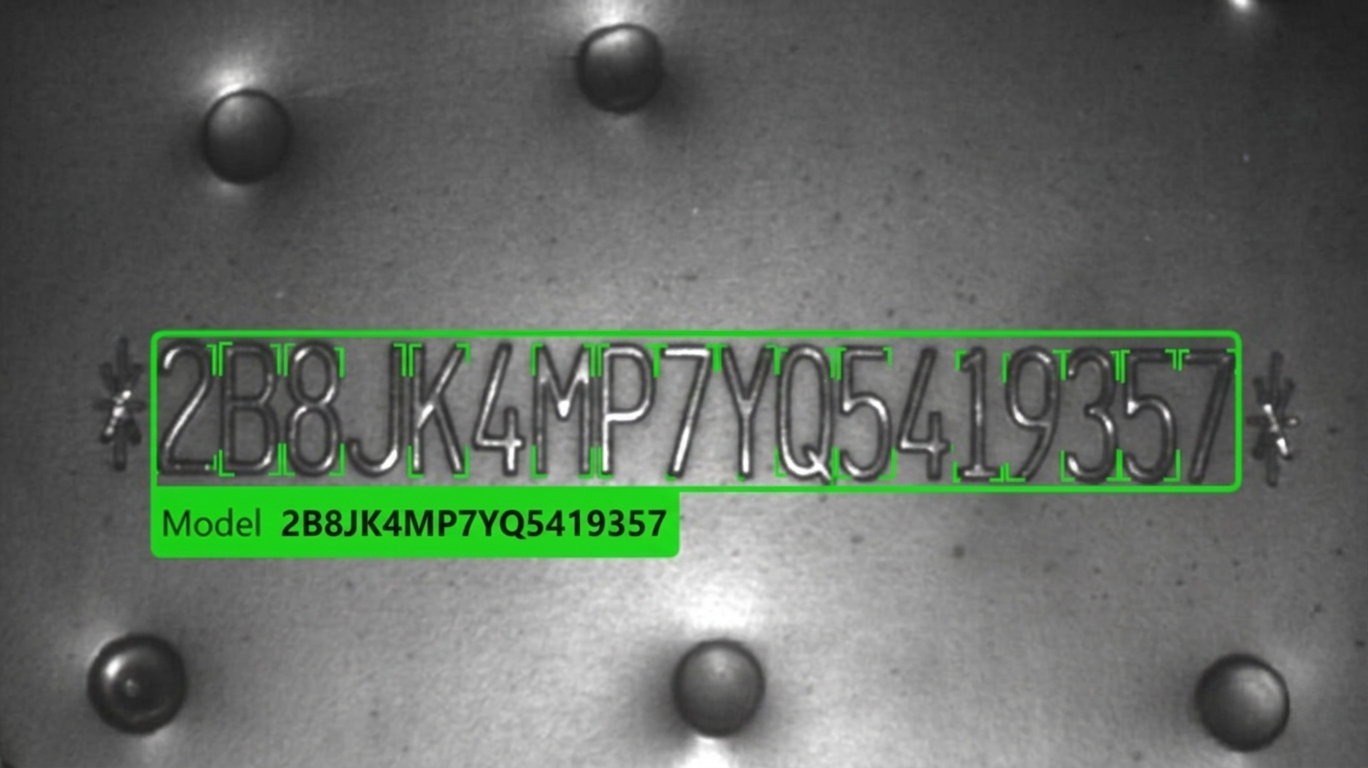
Industrial OCR code reading consists of the automatic capture, identification, and digitization of alphanumeric characters found on industrial elements such as containers, license plates, product codes, serial numbers, logistics labels, pallets, transport documentation, and more.
OCR stands for Optical Character Recognition. Its goal is to transform visible text into digital data that can be interpreted by computer systems.
In an industrial environment, this reading process must be automatic, real-time, highly accurate, require no human intervention, and operate under complex environmental conditions.
The difference compared to traditional OCR is enormous. While conventional OCR works with clean and static images, an industrial system must deal with moving objects, vibrations, adverse weather conditions, variable lighting, dirt and deterioration, long distances, and different fonts and formats.
That is why the technological evolution of industrial OCR has been essential to meet today’s traceability and automation requirements.

The Leap to Deep Learning: Overcoming Conventional OCR
For decades, conventional OCR systems were based on predefined rules and rigid patterns. They worked relatively well in controlled environments but suffered major limitations when facing any visual variation.
Deep Learning completely changes the paradigm. Through the use of convolutional neural networks (CNNs) and AI models trained on millions of images, modern systems can learn to recognize characters in extremely complex situations.
This allows industrial OCR code reading to achieve superior levels of accuracy even when the code is partially hidden, blurred by movement, affected by reflections or shadows, deteriorated, printed on irregular surfaces, or when multiple codes appear simultaneously.
In addition, AI-based systems can continuously adapt and improve over time through incremental learning.
OCR vs. OCV: Beyond Reading, Toward Quality Verification
The concepts of OCR and OCV are often confused, but they perform different functions within industrial automation.
OCR (Optical Character Recognition) is responsible for reading and converting characters into digital data.
OCV (Optical Character Verification), in addition to reading, verifies that the content is correct according to specific quality or validation criteria. In other words, OCV not only interprets characters but also checks that the code exists, is readable, follows the required format, contains no missing information, and matches the expected database.
For example, in a pharmaceutical production line, OCR can read a manufacturing batch number, while OCV validates that the format complies with regulations and that there are no printing errors.
The combination of both technologies makes it possible to:
- Reduce critical errors
- Guarantee labeling quality
- Comply with regulatory standards
- Improve traceability
- Prevent logistics incidents
In modern industrial environments, the trend is no longer just about reading information, but about automatically validating all visual data.

Real-Time Integration: Speed and Edge Computing
One of the most significant recent advances in industrial OCR code reading is its ability to operate in real time thanks to Edge Computing. Traditionally, images were sent to external servers for processing. This created latency, dependency on connectivity, bottlenecks, and security risks.
With Edge Computing, processing occurs directly near the capture source, such as smart cameras, industrial devices, or local servers.
Success Stories in Industrial OCR Code Reading
The application of advanced machine vision and Deep Learning systems is already transforming multiple industries. Below are some real-world examples of how industrial OCR code reading can solve critical traceability and automation challenges.
Success Story 1: Intelligent Traceability in the Livestock Industry
One of the most interesting projects recently carried out involved developing an advanced machine vision system for an industrial slaughterhouse with the goal of improving full traceability throughout the production process.
The Challenge: the company needed to correctly identify each animal during the production process in order to automatically associate it with the corresponding livestock supplier.
Until then, the traceability system was not robust enough. After the skinning and hanging process, they could no longer reliably identify which carcass belonged to each supplier, causing the final meat weight allocation to be performed approximately or “intuitively.”
This generated:
- Risk of traceability errors
- Production control issues
- Loss of precision in yield allocation
- Dependence on manual processes
The implemented solution: to solve the problem, an industrial OCR code reading system based on machine vision and artificial intelligence was designed to automatically read identifying tattoos marked on each animal.
The solution included:
- 2 industrial cameras
- 2 dedicated XG controllers
- Redundant PCs to ensure high availability
- Integration with SIEMENS PLCs
- RFID antennas for hook identification
- Centralized storage through NAS systems
The system was deployed on both production lines immediately after the carcass-opening robots.
System operation:
When the animal reaches the end-of-line sensor:
- The PLC detects the carcass movement.
- Image capture is automatically triggered.
- Simultaneously, the hook RFID is read.
- The OCR system processes the tattoo using machine vision algorithms.
- The information is automatically recorded.
All data is stored in both SQL databases and CSV files, including: registration time, RFID number, read tattoo code, associated image, production line.
Additionally, the Python-based software operates through parallel processing, allowing both production lines to be managed simultaneously in real time.
Results achieved:
Thanks to this implementation, the company managed to:
- Fully automate traceability
- Eliminate manual errors
- Improve supplier yield allocation
- Obtain real-time auditable records
- Increase slaughterhouse operational reliability
This project demonstrates how the combination of Deep Learning, industrial OCR, and RFID systems can solve complex processes even in extremely demanding environments such as the meat industry.

360° Traceability: Connecting Industrial OCR Code Reading with Your ERP/MES
The true power of industrial OCR code reading appears when it is integrated into the company ecosystem.
It is not only about data capture, but also about automatically connecting it with systems such as ERP, MES, WMS, TMS, logistics platforms, and industrial control systems.
The benefits of complete integration include:
- Full traceability: Every asset can be tracked in real time.
- Process automation: Data flows automatically between systems.
- Reduction of human errors: Repetitive manual tasks are eliminated.
- Operational improvement: Information is instantly available.
- Greater analytical capability: Captured data enables operational intelligence. For example, an OCR system can automatically detect the arrival of a truck, validate its license plate, identify the container, and update the ERP system without human intervention.
Security and Compliance
Industrial automation must also meet strict security and data protection requirements.
Modern industrial OCR systems incorporate advanced measures to guarantee:
- Protection of sensitive information
- Regulatory compliance
- Operational security
- Access control
- Event auditing
In critical sectors such as ports or logistics infrastructures, security is especially important. Furthermore, Edge Computing-based solutions help minimize risks by keeping much of the processing within the local infrastructure.
Compliance with regulations such as GDPR and international industrial standards will become increasingly important as automation continues to grow.
How to Implement an Advanced OCR System in 4 Steps
Implementing a modern industrial OCR code reading solution requires a clear strategy.
- Analyze the operating environment
It is essential to evaluate the type of codes, distance, speed, lighting conditions, operational volume, and required integrations. Every industrial environment has different needs.
- Choose the right hardware
Capture quality is critical for OCR performance. It is necessary to select the appropriate resolution, capture speed, robust industrial cameras, optimized lighting, and Edge infrastructure.
- Train specific AI models
Deep Learning allows the system to be customized according to code typology, formats, languages, and real environmental conditions. The more adapted the model, the higher the accuracy.
- Integrate with business systems
Finally, the OCR system must connect with ERP, MES, logistics platforms, databases, and automation systems. Integration is the key to transforming reading into real operational value.
Conclusion
The evolution of industrial OCR code reading is redefining automation across key sectors of the global economy.
The transition from traditional OCR to Deep Learning enables levels of accuracy, speed, and scalability that were unimaginable just a few years ago. Today, companies need systems capable of reading, verifying, and connecting information in real time under any operating condition.
In addition, technologies such as Edge Computing and ERP/MES integration are turning industrial OCR into a central component of Industry 4.0 and intelligent traceability.
Organizations that adopt these advanced solutions will not only reduce errors and operational costs, but will also gain analytical capabilities, security, and efficiency throughout their entire value chain.
The future of industrial OCR is already here, driven by artificial intelligence, automation, and real-time data.
Want to implement code reading solutions in your company? Contact us!