Is it possible to analyze the composition of a material without altering its physical state? The answer is yes. X-ray fluorescence (XRF) is an elemental analysis technique that identifies and quantifies the chemical elements present in a wide variety of materials quickly, accurately and virtually non-destructively.
XRF analysis has become a highly valuable tool for materials characterization and quality control. This technique can be applied to a wide range of materials, from metals and alloys to minerals, ceramics, glass, cement, polymers and industrial waste.
But what role do X-rays play in this process? The answer lies in the interaction between radiation and the atoms that make up the material. Find out more in this blog post. Don’t miss it!

What Is X-Ray Fluorescence?
X-ray fluorescence, known as XRF, is an analytical technique used to determine the elemental composition of a sample.
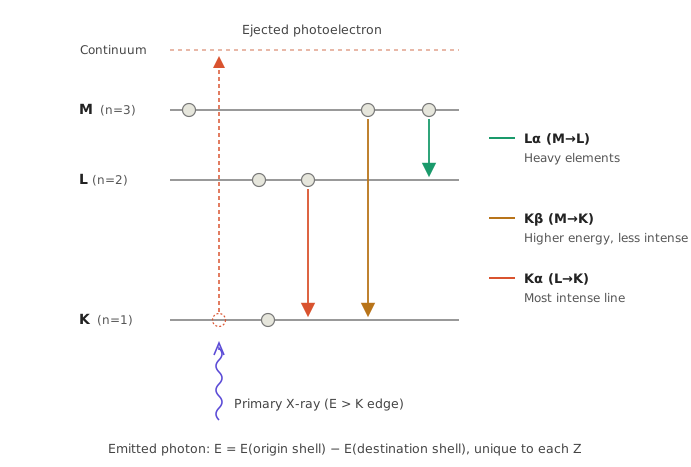
The technique works by irradiating the material with a high-energy X-ray beam. When this radiation strikes the atoms in the sample, it excites them and causes electrons to be ejected from their inner shells. As a result, a vacancy is created in the atom’s electron configuration, which is subsequently filled by an electron from a higher-energy shell.
During this process, energy is also released in the form of a secondary or fluorescent X-ray. The energy of this radiation is characteristic of each chemical element, acting as a kind of energetic fingerprint that makes it possible to identify the element.
Another key feature of this technique is that, in addition to identifying the elements present, it allows the intensity of the emitted radiation to be correlated with their concentrations, making both qualitative and quantitative analyses possible.
One of the main advantages of this technology is that the analysis can be performed directly on the sample, reducing the need for prior chemical treatments.
How Does an X-Ray Fluorescence Test Work?
X-ray fluorescence analysis can be divided into the following stages:
- Sample preparation: As this technique allows direct analysis of the material’s surface, the sample may require some prior preparation.
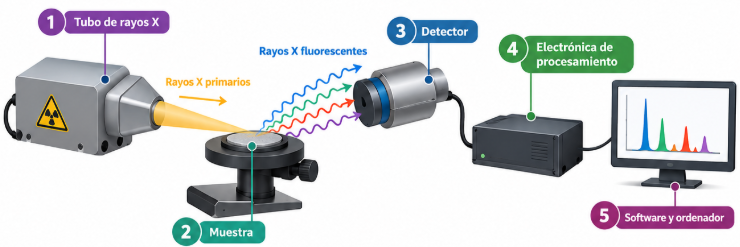
- X-ray irradiation: The sample is placed inside the instrument and irradiated with an X-ray beam generated by an X-ray tube. This radiation excites the atoms present in the material.
- Emission of characteristic radiation: Following excitation, the atoms emit secondary X-rays whose energy is characteristic of each chemical element.
- Detection: A detector records the characteristic radiation emitted by the sample and generates a spectrum containing peaks associated with the elements present.
- Identification and quantification: The instrument’s software analyzes the energies of the peaks to determine which elements are present and quantifies their concentrations based on a prior calibration.
Main Equipment and Components for an X-Ray Fluorescence Test
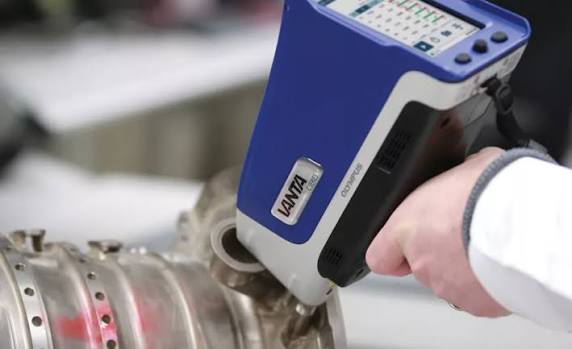
Although X-ray fluorescence instruments are available in different configurations, they all include a number of essential components.
- X-ray tube: generates the X-rays required to excite the atoms in the sample. The selection of the tube’s operating conditions influences which elements can be analyzed and the sensitivity achieved.
- Sample holder: positions the sample correctly in relation to the source and detector. Its configuration depends on the type and geometry of the samples.
- Detector: detects the characteristic X-rays emitted by the sample and enables their energy and intensity to be analyzed.
- Electronic system and software: processes the detector signal and converts it into a spectrum that enables the identification of elements, quantitative calculations and the generation of results reports.
- Safety and shielding system: incorporates shielding, interlocks and other safety measures designed to ensure that the analysis is carried out under controlled conditions, given the use of ionizing radiation.
Applications of X-Ray Fluorescence
One of the main strengths of this analytical technology is its versatility. As a result, it can be used to analyze materials across a wide range of industrial and scientific sectors.
- Metals and alloys analysis: determines the elemental composition of metallic materials and verifies alloy quality.
- Minerals and geological materials: analyzes rocks, minerals, soils and raw materials, making it possible to determine the presence of elements such as iron, calcium, silicon, aluminum and potassium, among others.
- Cement, ceramics and construction materials: characterizes raw materials and finished products and helps control their chemical composition.
- Glass and inorganic materials: facilitates quality control of raw materials and finished products.
- Polymers and composite materials: detects and quantifies certain elements present in fillers, pigments, additives or contaminants.
- Waste and the circular economy: analyzes the elemental composition of waste to assess its recovery potential, identify contaminants and select the most appropriate treatment routes.
Advantages of X-Ray Fluorescence
The main advantages of XRF technology are as follows:
- Speed: analyses can be performed in a relatively short time, making the technique suitable for quality control and materials characterization.
- Multi-element analysis: a single test can detect numerous elements present in a sample.
- Minimal sample preparation: depending on the material and the purpose of the analysis, the sample may require only relatively simple preparation.
- Non-destructive analysis: in many applications, the sample can be preserved after analysis, although this depends on the instrument configuration and the procedure used.
- Versatility: laboratory instruments, benchtop systems and portable devices are available to meet different needs.
- Reproducibility: when appropriate sample preparation, calibration and quality control methods are used, XRF can provide consistent results across a wide range of applications.
- Reduced use of chemical reagents: compared with certain analytical techniques that require chemical digestion, XRF can significantly reduce the need for reagents and the generation of laboratory waste.
Conclusion
X-ray fluorescence (XRF) is a technique that makes it possible to determine the elemental composition of materials by analyzing the characteristic radiation emitted by their atoms when excited by X-rays.
Its speed, versatility and minimal sample preparation requirements make it a valuable tool for materials characterization, quality control, research and development, and waste recovery.
Ultimately, XRF turns a seemingly simple question — “What is this material made of?” — into useful analytical information that supports decision-making regarding manufacturing, quality control, use and recovery.
Do you need XRF analysis for your samples as part of one of your projects? Get in touch with us!