Digital transformation is changing the way companies design, manufacture, and manage their production processes. The integration of technologies such as artificial intelligence, robotics, the Internet of Things, and data analytics enables industries to become more efficient, flexible, and competitive. In this context, Industry 4.0 has emerged as a production model based on connectivity and the intelligent use of data, transforming both factories and the role of the people who work in them.
In this article, we will explain what Industry 4.0 is, the technologies it uses, and its many benefits for the industrial sector.

What is Industry 4.0?
The term Industry 4.0 was first introduced in 2011 and essentially refers to the Fourth Industrial Revolution. While the First Industrial Revolution was driven by the steam engine, the Second by electricity and mass production, and the Third by electronics and information technology, the Fourth is characterized by cyber-physical systems—machines, products, management systems, and people connected to one another and exchanging data in real time.
Therefore, Industry 4.0 is not simply about increasing automation, but about leveraging the data generated by the production process itself to improve efficiency, increase flexibility, and make faster, better-informed decisions.
What technologies does Industry 4.0 use?
There is no definitive list of the main technologies being used, as the field is constantly evolving and innovating. However, in our view, the most widely used technologies include:
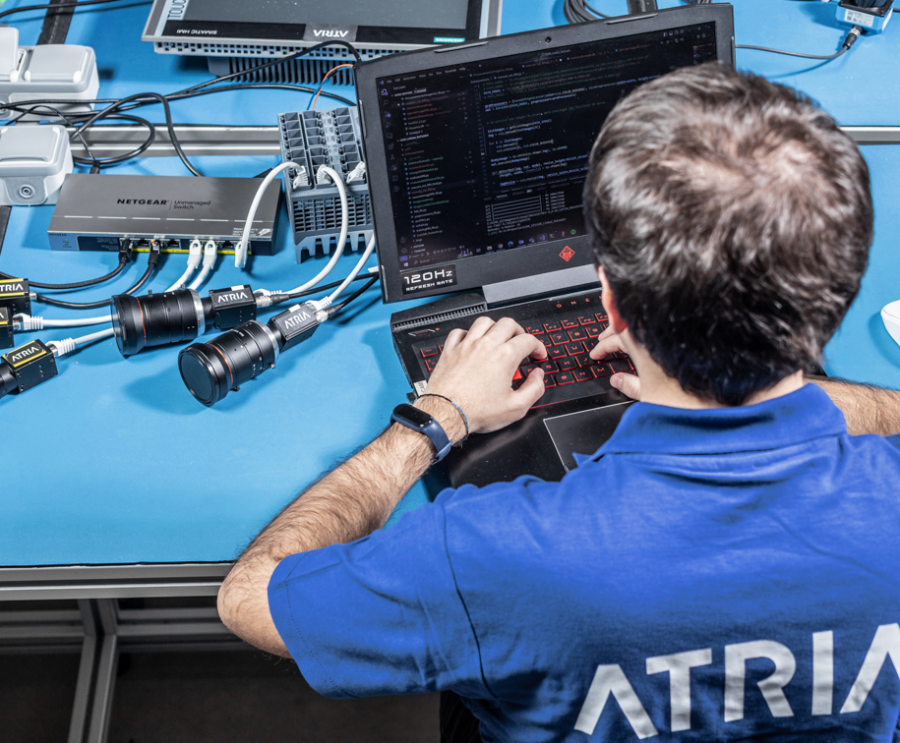
- Machine vision. It provides process information through images and is used in a wide range of applications, such as quality control, defect detection, code reading using OCR, and object position estimation. There are sensors for every need: high-resolution 2D cameras, 3D systems such as laser profilometry, thermal cameras, and hyperspectral cameras.
- Collaborative robotics (cobots). In this case, robots share the workspace with people thanks to sensors and safety functions that limit their force and speed. Combined with machine vision, they can perform precise assembly operations, pick & place tasks, and picking of parts in unstructured environments.
- Augmented reality. Beyond consumer applications and marketing, augmented reality is used on the shop floor to guide maintenance, assembly, and packaging tasks and to improve workplace ergonomics.
- Artificial intelligence and machine learning. The application of neural networks and machine learning algorithms makes it possible to use data for classification, prediction, and decision-making, from automated inspection to predictive maintenance. Their accuracy depends on both the quantity and the quality of the data used for training.
- Internet of Things (IoT). It enables sensors, machines, and management software to be interconnected so that they can interact with one another, centralizing information and providing greater control over processes.
- Cybersecurity. Cybersecurity has emerged precisely because of the need to secure new interconnected infrastructures and protect industries against cyberattacks. As a result, new machines are increasingly being designed and manufactured with cybersecurity measures that help prevent and protect against these threats.
- Big data, cloud, and edge computing. Analyzing data makes it possible to identify patterns and failure modes, optimize processes, and plan maintenance. The cloud provides scalable storage and computing capacity, while edge computing processes data close to the machine when a real-time response is required.
- Simulation and digital twins. A virtual replica of a machine, production line, or product, fed with real-world data, makes it possible to test changes and adjust parameters before making changes to production, reducing setup times and enabling faults to be detected before they occur.
- 3D printing. Additive manufacturing enables rapid prototyping and allows companies to manufacture tooling, supports, spare parts, and even final components directly on the production floor, reducing lead times and costs.

Industry 4.0 in Spain and around the world
Since its emergence, Industry 4.0 has become an industrial policy objective for countries around the world, although each country approaches it with its own strategy and funding model: the United States with its advanced manufacturing programs, China with Made in China 2025, and Japan with Society 5.0. In the European Union, the debate has evolved towards Industry 5.0, which complements Industry 4.0 by placing greater emphasis on people, sustainability, and resilience.
In Spain, the Ministry of Industry promotes the Connected Industry 4.0 strategy, which includes the HADA self-assessment tool and the Activa Industria 4.0 program, which provides specialized advice to industrial SMEs. In addition, according to the European Commission’s 2026 Digital Decade Country Report, 20.3% of Spanish companies were already using artificial intelligence in 2025, compared with 11.3% the previous year. However, SMEs still have room for improvement in cloud adoption and in more advanced levels of digitalization.
If you would like to learn more about the growth of the industrial sector in Spain, you can visit our post: Comparison of Industry 4.0 in Spain and Other Countries

Benefits of implementing Industry 4.0
In this context, companies that integrate these technologies can improve productivity, quality, and cycle times, increase traceability and flexibility when customizing products, and reduce energy consumption and waste.
There is also a less visible but equally important advantage: having reliable real-time process data makes it possible to identify problems before they result in downtime or defective products, shifting from corrective to predictive maintenance. In addition, automating repetitive or hazardous tasks improves workplace safety and ergonomics, while the ability to quickly adapt production makes companies more competitive in response to changes in demand.
These benefits are not exclusive to large companies. Many SMEs start with a pilot project focused on a specific problem, such as automating a quality inspection, and, once the results have been validated, extend it to other areas. We explore this topic in greater depth in Advantages of Industry 4.0 for Companies.

Workers in Industry 4.0
Industry 4.0 does not eliminate people from the factory, but it does transform their role. Repetitive or ergonomically demanding tasks are automated, while supervision, programming, data analysis, and the maintenance of increasingly complex systems become more important. Today’s and tomorrow’s workers need to understand the technologies they work with, even if they are not specialists in all of them.
This is giving rise to increasingly hybrid roles that combine knowledge of production processes with digital skills. For example, operators who adjust a cobot or interpret data from their production line, or maintenance technicians who work with sensors and software.
Given the speed at which technology is advancing, continuous training and the ability to adapt to new technologies have become essential. Companies have a key role to play here: providing ongoing training and involving workers from the very beginning of each digitalization project, as they are the people who know the production process best. We explore this topic further in our post Workers in Industry 4.0.
Finally, as mentioned above, there is an increasing focus on more sustainable models centered on the role of people within the production process, where technology is not an end in itself but a tool that serves workers. This lays the foundations for Industry 5.0, which we discuss in Industry 5.0: What Is It?. Rather than representing a revolution, Industry 5.0 will be a complementary evolution of these advances.

If you would like to learn more about Industry 4.0 or how it is transforming the industrial sector, contact us!