Testing
We select and conduct tests that best suit your needs and those of your product, utilizing our wide range of equipment to ensure its quality and safety.
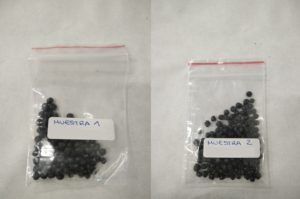
We characterize polypropylene and EPDM TPV thermoplastic vulcanizates through transmission electron microscopy (TEM) and atomic force microscopy (AFM) to improve their manufacturing process.
Our customer, a technology center, wants to improve the current manufacturing process of one of its thermoplastic vulcanized (TPV) materials composed of a mixture of polypropylene and EPMD. Our client’s ultimate goal is to see if making changes to the production parameters can result in higher quality TPV materials.
The first step was the selection of the most appropriate technique to study the thermoplastic. In this particular case we chose transmission electron microscopy (TEM) and atomic force microscopy (AFM).
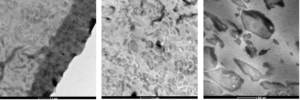
The first of the techniques we used was transmission electron microscopy (TEM).
Thanks to the nanometer resolution when measuring with this technique, we can differentiate physical elements and chemical compositions of nanometer points of the material.
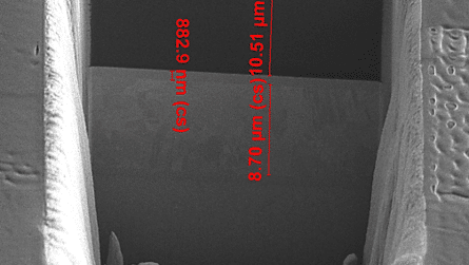
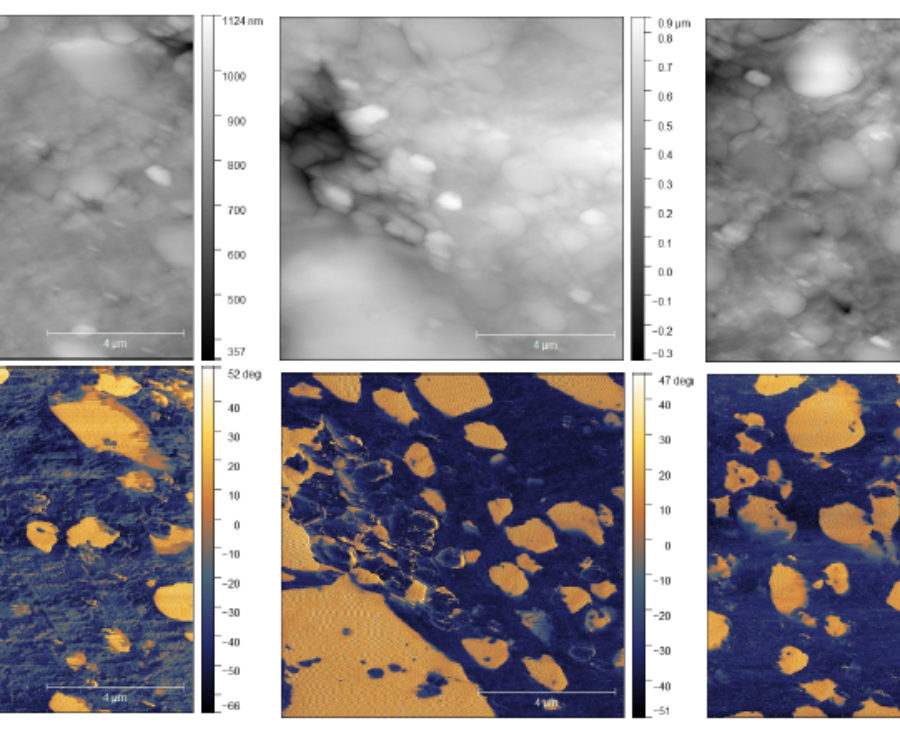
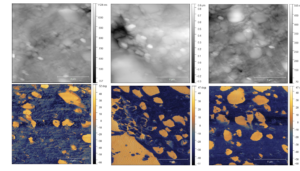
Next, we used atomic force microscopy (AFM) and performed a cryoultramicrotomy cut, cutting the sample at -110ºC. The objective was to achieve the highest possible flatness, to allow the vibrational interaction of the AFM measuring tip to undergo a continuous measurement on the surface, and as a consequence, result in measurements with the lowest possible variability. After that, we performed a topography and phase analysis of the materials present in three different areas of the zone and at three different magnifications, which allowed, in a random and reproducible way for each sample, to evaluate the distribution of the EPDM particles embedded in the PP matrix.

Your success is our goal. We want to be your partner in the development of your projects, leveraging the power of innovation, flexibility, and the trust we provide. Together, we make a difference through new technologies.
Contact us and let’s build the future together!
We are a team of experts passionate about industrial innovation, committed to excellence, and the success of our clients.


Subscribe to our newsletter, and we’ll send you all the content that interests you directly to your email.