Technologies
24 February 2026
The present and future of quantum computing
Discover the most significant advances in quantum computing, the challenges that still remain, and the true potential of quantum computers.

Artificial intelligence in factories is transforming the way companies produce, manage, and optimize their industrial processes. In an increasingly competitive and efficiency-driven environment, the adoption of intelligent technologies has become a decisive factor in improving productivity, quality, and the ability to adapt to change.
To understand the true scope of this transformation, it is essential to start by defining what artificial intelligence is and why it is key to the future of industry.
In recent years, artificial intelligence (AI) has gained enormous visibility, although its definition is often reduced to some of its applications rather than the full range of capabilities it offers. AI refers to a set of technologies that enable machines to simulate human processes such as learning, reasoning, and decision-making. This includes everything from complex rule-based systems defined by experts to Large Language Models (LLMs) such as ChatGPT. In the context of factories, AI focuses on leveraging data and advanced algorithms to optimize operations, reduce costs, and improve product quality.

The importance of AI in modern factories lies in its ability to address complex challenges in an increasingly competitive industrial environment. The combination of large volumes of data generated by sensors, machinery, and systems connected through the Internet of Things (IoT), together with machine learning algorithms, enables fast, evidence-based decision-making that goes beyond the limitations of traditional approaches. Likewise, production fault-detection systems using computer vision, collaborative and adaptive robotics, and data-driven diagnostic or predictive systems rely on AI capabilities to deliver solutions that were impossible just a few years ago.
Advanced automation goes far beyond conventional robotic production lines. Machines can now adapt to unforeseen situations, learn failure patterns to prevent unexpected downtime, and optimize workflows in real time. This is transforming the manufacturing industry and paving the way toward smarter, more efficient, and more sustainable factories, where every resource is used optimally.
In a completely different domain, Large Language Models are helping executives, engineers, marketing professionals, designers, and many other profiles generate ideas, automate tasks, and increase productivity across all stages of the industrial production process. In this model, AI acts as a consultant and reviewer of human work, helping to prevent errors. In a world where personalization and speed are critical, AI not only improves production but also redefines factory operating models to adapt to the demands of future markets.

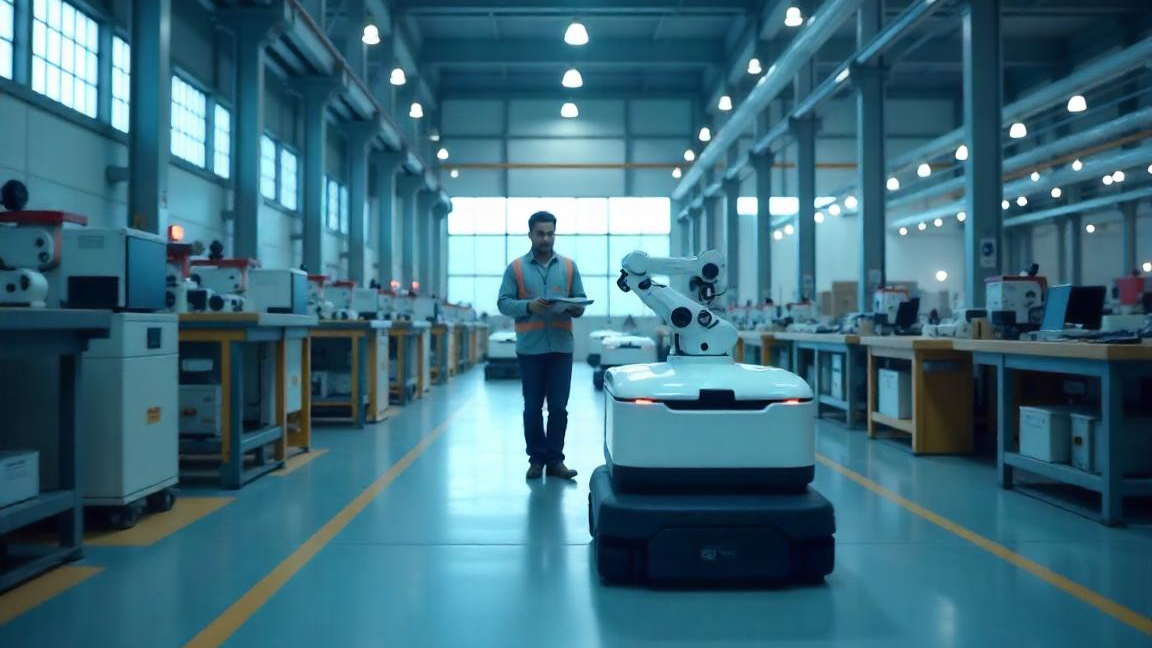
Industries face multiple technical, organizational, and economic challenges when effectively implementing these solutions in industrial environments. The main ones include:
Hyperautomation combines AI, advanced robotics, and data analytics to automate nearly all aspects of factory operations, including physical tasks as well as administrative and decision-making processes. In the past year, the rise of agentic systems—rule-based multi-agent systems that coordinate multiple Large Language Models to solve complex tasks—has significantly increased efficiency for both blue-collar and white-collar workers. In the near future, fully automated processes capable of predicting and resolving problems without human intervention will become possible. While this requires AI-centric production line design from start to finish, companies can still benefit incrementally from individual stages without undergoing a full transformation.
Future factories will be fully interconnected and intelligent, operating as digital ecosystems. IoT sensors will collect real-time data, while AI will analyze it to optimize every stage of production, responding to stock shortages, production line issues, and bottlenecks that can be automated. These “smart factories” will automatically adapt to demand changes or operational problems, minimizing disruptions.
Digital twins—virtual replicas of physical equipment or processes—will also be a key trend. These models will allow factories to simulate and predict system behavior in real time, improving planning and reducing risk. They will enable testing efficiency improvements in new production systems before physical deployment, significantly lowering innovation costs.

AI-driven adaptability may allow factories to make drastic production format changes without incurring prohibitive costs or operational disruptions. This could lead to new business models such as “factories as a service”, where facilities are rented to companies needing temporary production lines, fully managed by autonomous systems supported by AI and data experts.
AI will also play a crucial role in the green transition toward more sustainable practices by optimizing energy consumption, reducing waste, and minimizing environmental impact. Energy efficiency, waste reduction and reuse, and AI-enhanced design and testing phases could dramatically reduce operating costs, enabling near-“zero-friction” business models where factories operate like perfectly calibrated Swiss watches. At the same time, supply chains will become fully automated—from raw material sourcing to final delivery—optimizing time and reducing costs.
Finally, factory-floor workers will collaborate closely with AI-guided robots and consult copilot systems based on Large Language Models, computer vision, and voice recognition. These systems will help solve problems, connect workers, manage task and communication inboxes, and even provide entertainment to reduce the psychological burden of repetitive tasks.
Interested in learning more about artificial intelligence in factories? Contact Us!

Your success is our goal. We want to be your partner in the development of your projects, leveraging the power of innovation, flexibility, and the trust we provide. Together, we make a difference through new technologies.
Contact us and let’s build the future together!