Microperforation
We create tiny holes in a material, thereby modifying its properties, allowing us to control the flow of elements passing through it.
Design and realization of prototypes with precise microperforations of 15 μm diameter in polymeric membranes.

Our client is studying the behavior of new membranes based on polymeric biomaterials. To do so, he needs to make microperforations of 15 μm diameter and prototypes with different porosities and geometries. The challenge of the project lies in the small size of the microperforations and the strict tolerances of the required separation distance between them.
The first step was to configure our laser equipment with the appropriate optical components that would allow the beam to be precisely focused on an area as small as that required for the microperforations.
Next, calibration and alignment tests were performed on the optical system, optimizing key parameters such as beam focus, pulse energy or the number of repetitions required. This ensured uniform and accurate drilling in the materials. In parallel, the laser equipment was programmed to perform the drilling patterns with the different geometries and porosities.
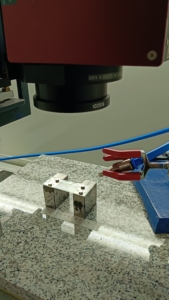
Multiple test iterations were carried out on the prototypes, adjusting the parameters according to the results obtained. The membranes produced were subjected to an exhaustive morphological analysis to evaluate the uniformity of the microperforations and that their diameters remained within the required range.

The material provided had a high value due to its ad-hoc manufacturing process, so the client sent us only the amount strictly necessary. We established fluid, flexible and effective communication with the client from the outset, which allowed us to jointly define the objectives and optimize the use of the available material. This collaborative approach ensured that the expected results were achieved, while respecting the constraints imposed by the nature of the supply.
In the end, several batches of prototypes were produced in various configurations, which met the customer’s design requirements.

Your success is our goal. We want to be your partner in the development of your projects, leveraging the power of innovation, flexibility, and the trust we provide. Together, we make a difference through new technologies.
Contact us and let’s build the future together!
We are a team of experts passionate about industrial innovation, committed to excellence, and the success of our clients.


Subscribe to our newsletter, and we’ll send you all the content that interests you directly to your email.