Technologies
24 March 2026
Computer vision in the food industry
We explain how computer vision is transforming the food industry and improving the quality, safety, and efficiency of said industry.

The application of coatings on materials is one of the most used strategies in the industry to improve their properties. By deposition of coatings, a wide range of characteristics of a material can be improved, from a tribological point of view to an aesthetic point of view.
In today’s blog, we present a technology that has great potential in the application of coatings. This technology is physical vapor phase deposition (PVD).
The origin of physical vapor deposition (PVD) arises from the combination of electricity, magnetism and the knowledge of chemistry in the gas state.
The concept of physical vapor deposition arose when coatings applied in a vacuum atmosphere were on the rise. In these years, different developments in technologies such as sputtering or plasma were carried out, where chemical reactions in the vapor state, thermal evaporations and the control of energy sources were involved.The PVD technique is a process in which a thin film deposition occurs on the surface of a material, growing atom by atom on the substrate. The physical deposition of vapor consists of a physical-thermal collision process that transforms the material to be deposited, called the target, into atomic particles, which are directed to the substrates in a gaseous plasma state through a vacuum atmosphere, generating a physical coating by condensation of projected atoms.
Coatings deposited by PVD tend to have thin thicknesses, which can range from atomic layers (less than 10 angstroms (Å) to 0.1 nanometers (nm)) to coatings of several microns (thickness of a hair fiber).

Despite the fact that the process of evaporation and ionization of the target, which will finally make up the coating on the substrate, will always be physical in nature (hence the name of physical vapor deposition), there are different technologies that use PVD for the application. of coatings.
The most important and widely used PVD technologies are:
In this type of PVD technology, the acceleration of ions by means of plasma allows the impact of these with the surface of the objective to produce the release of particles from it. The ions transfer their kinetic energy to the surface of the target and vaporize. This type of PVD is characterized by allowing the deposit of compounds that arise when the target reacts with the gas present in the plasma. The most characteristic example is the deposition of titanium nitride (TiN), in which the gas present is nitrogen and the target is titanium, both reacting to give rise to a coating of TiN.
This type of PVD methodology is characterized by the fact that the target evaporates through a vacuum heating process and forms a vapor flow, which hits the substrate in the process chamber, resulting in adhesion of the coating. In this process, the vacuum atmosphere plays a special role as it prevents contamination of the coating formed.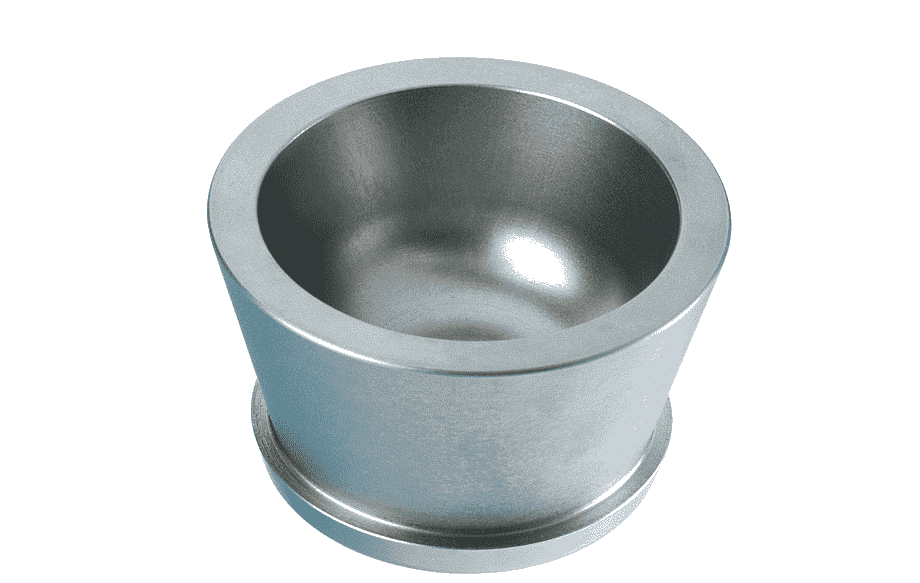
In this PVD technology, an arc of high intensity and low voltage electric current is applied, raising the temperature until the particles of the objective sublimate, evaporating highly ionized in the vacuum chamber. The ionized particles are directed to the substrate by applying a potential. In arc deposition, the target can act as a cathode (cathode arc) or an anode (anodic arc), depending on its nature and the coating to be obtained. Like sputtering deposition, coatings with certain compositions can be achieved by reacting the target ions with a reactive gas.
In this PVD technique, the evaporation of the target occurs with the same processes as previously seen (sputtering, thermal evaporation or electric arc). The difference lies in the use of a high energy inert ion bombardment (commonly Argon) to control and modify the coating obtained on the substrate. The main characteristic of this technique is that it allows obtaining pure metallic coatings without atomic contamination.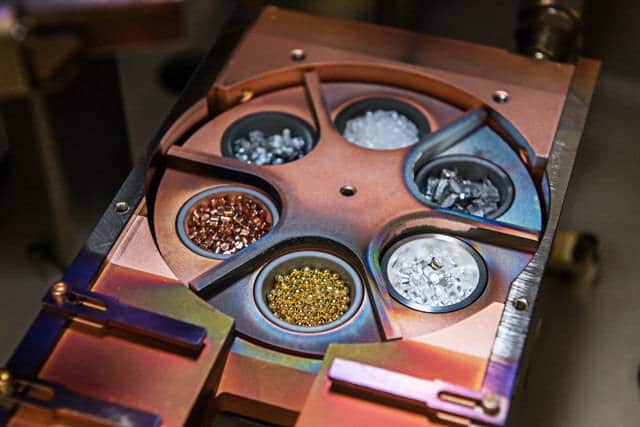
Today we have a wide range of techniques for depositing coatings. Each of them have specific applications, with their advantages and disadvantages.
Next, we present the main advantages of physical vapor deposition.
The main disadvantages of PVD are:
PVD applications
As we introduced PVD at the beginning of this blog, it is worth highlighting the precision and purity offered by physical vapor deposition to obtain coatings. The main PVD applications currently in use are as follows:
Below, we are going to show you some of the projects carried out by the ATRIA team where coatings obtained were used por PVD:
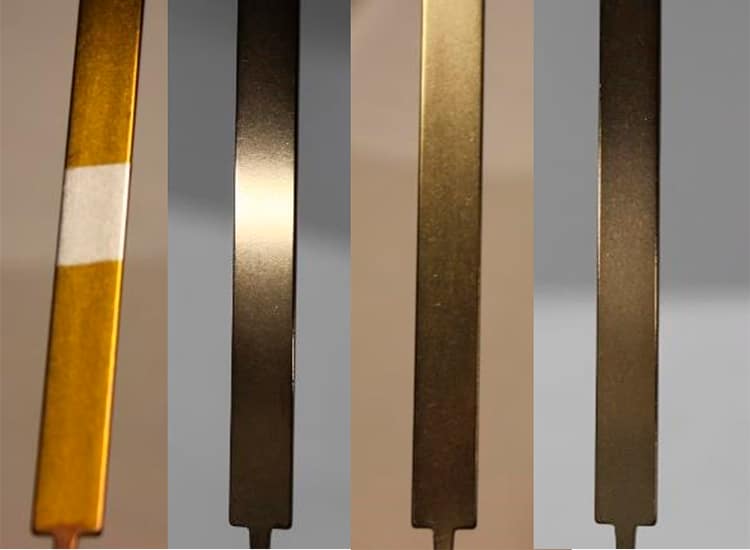
Development of golden colors using physical vapor deposition technology. In this project, the objective was to obtain different shades of golden color on metallic substrates. To carry it out, the optimization of the PVD process of different metallic targets and reactive gases was carried out. As can be seen in the photo, it was obtained from an intense gold to a lighter gold with pink tones.
Development of metallic films as barriers against corrosion. In this project, our corrosion occurred on a metallic substrate coated with different metallic layers when exposed to certain environmental conditions. The solution proposed by ATRIA was the development of an inert metallic coating under these environmental conditions and deposited by means of PVD. The purpose of said coating is to provide great resistance to wear and corrosion
 Do you want to apply coatings by physical vapor deposition in any of your Projects? Would you like to improve the properties of your materials through PVD technology? Contact us!

Your success is our goal. We want to be your partner in the development of your projects, leveraging the power of innovation, flexibility, and the trust we provide. Together, we make a difference through new technologies.
Contact us and let’s build the future together!