Technologies
10 March 2026
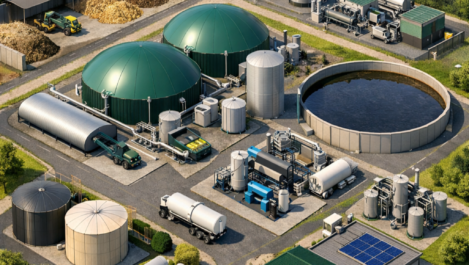
Biogas analysis, key parameters and examples
In today’s post, we explain in detail the analysis of biogas samples carried out by ATRIA.

Globalization has made the logistics sector a very important part of industrial processes. Code readers are essential equipment in the world of logistics since they allow the traceability of packages and merchandise, both during transport and during storage.
Traceability is essential for improving resource management and for manufacturing and subsequent processes to be agile and safe. With code reading it is possible to track production from the beginning to the end of the process. It is possible to perform the reading of codes without stopping the production processes and automatically. This is especially useful in security elements or in the food industry. The reading of codes also provides agility to transport processes since they allow control of shipments and their location.
There are two groups of barcodes, the traditional ones known as 1D codes and 2D codes. Traditional barcodes are made up of parallel bars, however, 2D codes have two dimensions and are capable of holding more information, for example, QR or datamatrix codes.
Depending on the type of code, we must use one type of reader or another, but saving these differences, these teams can be fixed or mobile depending on the needs of the process.
The mobile readers can have a pistol format, these are very robust and are specially designed for the industry and for logistics warehouses. They have a lot of power both in range and battery and are very accurate in reading even on different surfaces. On the other hand, there are “hands-free” readers or ring readers, these allow total freedom of movement since the operator will have his hands free to perform other tasks at the same time, they are totally wireless and provide agility and efficiency to the processes.

Fixed readers allow scanning at high speed and distance with great precision. They can directly read codes on objects on a conveyor belt or in environments with dust, humidity etc. Its main characteristics are the ability to adapt to all types of applications and the speed of reading.

If we take into account the technology on which they are based, we can distinguish several types of code readers. CCD readers emit LED light and from it collect the information of the codes. There are several types since some of them only read 1D codes and other 2D codes. Laser scanners emit laser light in a pattern that allows the code to be decoded. They can read codes at very great distances and work very well on the move. In addition to barcodes, there is also the possibility of reading alphanumeric codes. In these cases, the reading of codes can also be done from images with a camera, you can see an example of a project carried out by ATRIA for reading alphanumeric codes.
There is another form of labeling widely used in logistics and it is RFID. Next, we are going to analyze barcodes and RFID systems to see their advantages and disadvantages. RFID technology is based on radio frequency identification and is already used in many sectors. The labels or tags carry a storage chip that contains all the product information. Code Readers are highly reliable in their readings and are easy to implement, however, the labels can be easily damaged, which would prevent them from being read, and the information that can be stored on them is limited. RFID tags are very robust and can store more data as well as modify it. Labels can also be read from any position. Do you want to use code readers in any of your Projects? Contact us!

Your success is our goal. We want to be your partner in the development of your projects, leveraging the power of innovation, flexibility, and the trust we provide. Together, we make a difference through new technologies.
Contact us and let’s build the future together!